

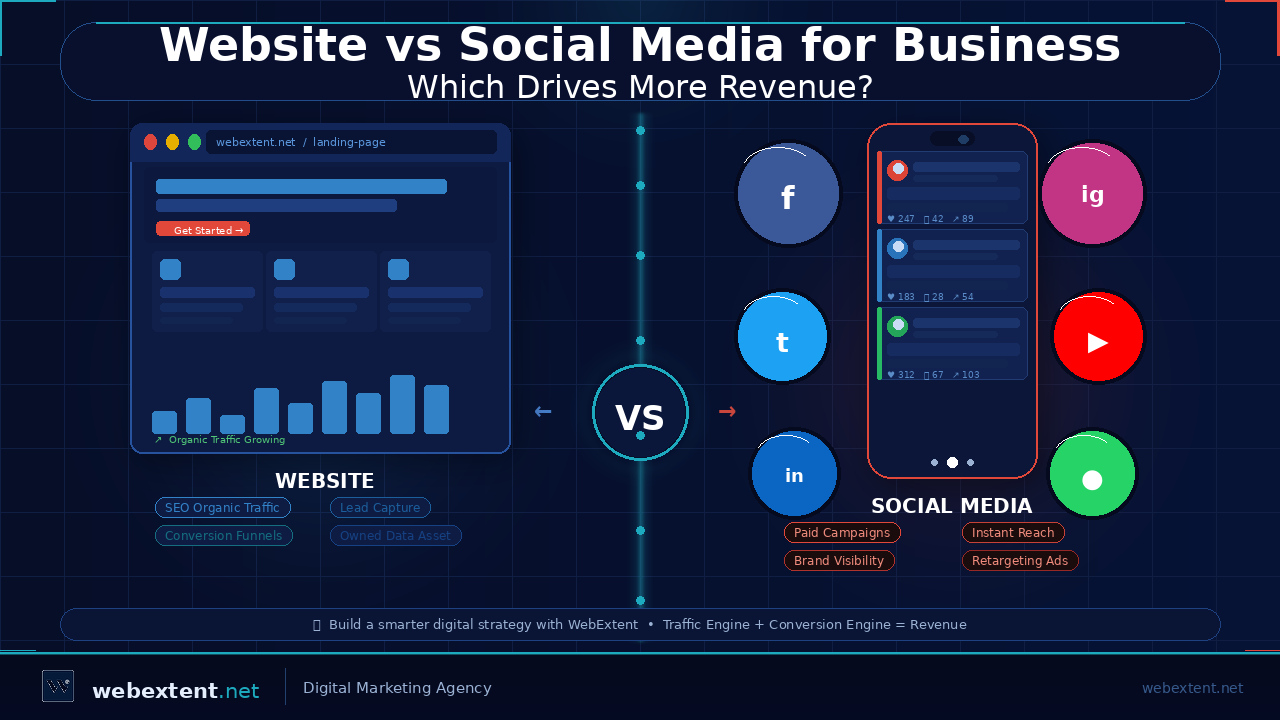

The question of website vs social media for business comes up in almost every strategy conversation — and it’s rarely a simple one. You’ve seen brands generate quick sales from a boosted Facebook post. You’ve also seen competitors rank on page one of Google and pull in steady enquiries without a single paid ad. So which approach actually grows revenue?
The honest answer is that framing it as a choice is the first mistake most businesses make. However, before we get to that, it’s worth understanding what each channel does well, where each one falls short, and — most importantly — what the data tells us about how revenue is actually generated in each case.
This article is written for business owners who want clarity, not hype. We’ll keep it direct, strategic, and focused on one thing: commercial results.
How a Website Drives Revenue Compared to Social Media
Think of your website as your digital headquarters. It’s open 24 hours a day, it belongs entirely to you, and — when built correctly — it works as a conversion system rather than just an online brochure.
The most significant commercial advantage a website offers is organic search traffic. Through a well-executed SEO strategy, your website attracts visitors who are already searching for what you sell. That intent-driven traffic converts at a meaningfully higher rate than cold ad traffic, because the visitor is already halfway to a decision before they arrive.
Beyond search visibility, a website gives you complete control over the buying journey. You can design landing pages around a single offer, integrate booking systems, capture leads through forms, and build email lists that you own outright. Every conversion is trackable. Every user journey is measurable. And crucially, the SEO authority you build compounds over time — a page that ranks today can generate leads for years without additional spend.
Perhaps most important from a business risk perspective: your website is an asset. No algorithm can remove it overnight. No policy change can suspend your account. You own the domain, the data, and the customer relationships built through it.
How Social Media Supports Revenue in Website vs Social Media Strategy
Social media marketing — across Facebook, Instagram, TikTok, and LinkedIn — gives businesses something a website takes months to build: immediate reach. A well-targeted paid campaign can put your offer in front of thousands of relevant prospects within 48 hours of launch. For new businesses, product validation, or time-sensitive promotions, that speed is genuinely valuable.
The targeting capabilities on platforms like Meta are also exceptional. You can define your audience by demographics, interests, behaviour, and purchase intent with a precision that organic search cannot match at early stage. Retargeting — showing follow-up ads to people who’ve visited your site or interacted with your content — adds another layer of commercial utility.
In addition, social media builds brand familiarity through consistent presence. When customers see your business regularly in their feed, trust accumulates passively. For product-based businesses especially, this ambient visibility can meaningfully support conversion rates when those customers are ready to buy.
The important caveat: social media excels at generating attention and driving traffic. Converting that attention into consistent, scalable revenue requires infrastructure that most social platforms cannot provide on their own.
Website vs Social Media for Business: A Direct Comparison

| Factor | Business Website | Social Media Marketing |
| Asset Ownership | Full ownership — domain, data, content | Platform-owned; you can lose access overnight |
| Traffic Type | Organic (SEO) + paid + referral | Primarily paid ad traffic |
| Conversion Control | Complete funnel design with custom CTAs | Limited by platform UI and feed environment |
| Revenue Longevity | Compounds over time via SEO equity | Stops the moment ad spend stops |
| Customer Data | Full first-party data ownership | Restricted to platform analytics only |
| Risk Exposure | Low — you own and control the asset | High — algorithm and policy changes |
| Speed to Results | Slower (3–6 months for organic traction) | Fast — visibility within days of launch |
| Cost Model | Upfront investment + low maintenance | Ongoing recurring ad spend required |
| Scalability | Highly scalable with compounding returns | Scales with budget, not with time |
| Trust & Credibility | Strong — SEO rankings signal authority | Moderate — ad-driven awareness |
Website vs Social Media: How Each Channel Generates Revenue
Revenue Through Your Website
A website generates revenue through a combination of organic search traffic, paid traffic funnels, and direct conversion architecture. Organic visitors who arrive via SEO are typically high-intent — they searched for a specific solution and found you. Therefore, they require less persuasion and convert at higher rates.
Well-designed landing pages take this further. Unlike a homepage, a landing page is engineered around a single action — a consultation request, a purchase, a sign-up. Every element on the page reduces friction and guides the visitor toward that one outcome. When combined with lead capture forms and email marketing, your website becomes a system that generates revenue continuously, not just when a campaign is active.
Retargeting integration adds another dimension. Visitors who don’t convert on the first visit can be recaptured through follow-up ads — and those warm audiences consistently convert at a lower cost than cold traffic. The result is a revenue loop that grows more efficient over time.
Revenue Through Social Media Marketing
Social media generates revenue most effectively through paid campaigns with a clear offer, a defined audience, and a purposeful destination. Direct selling via Instagram Shopping or Facebook Marketplace works well for product businesses. Limited-time promotions and flash campaigns thrive in the social feed format, where urgency and visual impact drive immediate action.
However, the revenue generated through social media is largely campaign-dependent. When spend stops, visibility stops. There is no compounding effect — every campaign starts from zero. For businesses whose entire digital strategy lives on social media, this creates a ceiling that becomes increasingly expensive to push through as audience acquisition costs rise.
The Ownership Problem: Why Platform Dependency Is a Revenue Risk
This dimension of the website vs social media for business discussion is often overlooked until it causes real damage — and by then, it’s expensive to fix.
The debate around website vs social media should always center on ownership and conversion power.
When you build your business primarily on social media, you are building on rented infrastructure. Facebook’s organic reach has declined dramatically over the past decade. Accounts are suspended without prior warning. Ad policies change in ways that can make previously compliant campaigns non-compliant overnight. Entire business categories have found themselves locked out of advertising on platforms they had invested years in building.
In contrast, a business website sits on infrastructure you control. Your domain is your address. Your content is your intellectual property. Your customer data — captured through forms, email lists, and analytics — belongs to you. SEO authority built through quality content and backlinks doesn’t evaporate because a platform updated its algorithm.
| The critical distinction: social media gives you access to an audience. A website gives you ownership of a customer relationship. For long-term revenue stability, ownership matters far more than access. |
Short-Term Visibility vs Long-Term Revenue Equity
When analyzing website vs social media for business growth, companies must focus on long-term revenue impact rather than short-term visibility.
Social media advertising and website SEO operate on fundamentally different time horizons — and both have a legitimate place in a revenue strategy, depending on where your business is.
A well-executed Facebook campaign can generate enquiries within days of launch. That immediacy is genuinely useful, particularly when cash flow is a priority or when you’re testing a new offer. However, the moment you stop paying, the enquiries stop. There’s no residual value. Every pound spent on social advertising buys temporary visibility, not permanent equity.
SEO builds differently. The first three months may show limited return. By month six, organic traffic typically begins to grow. By month twelve, a business investing consistently in content and technical optimisation begins to see compounding results. Rankings that are earned through genuine authority tend to hold even when marketing spend fluctuates.
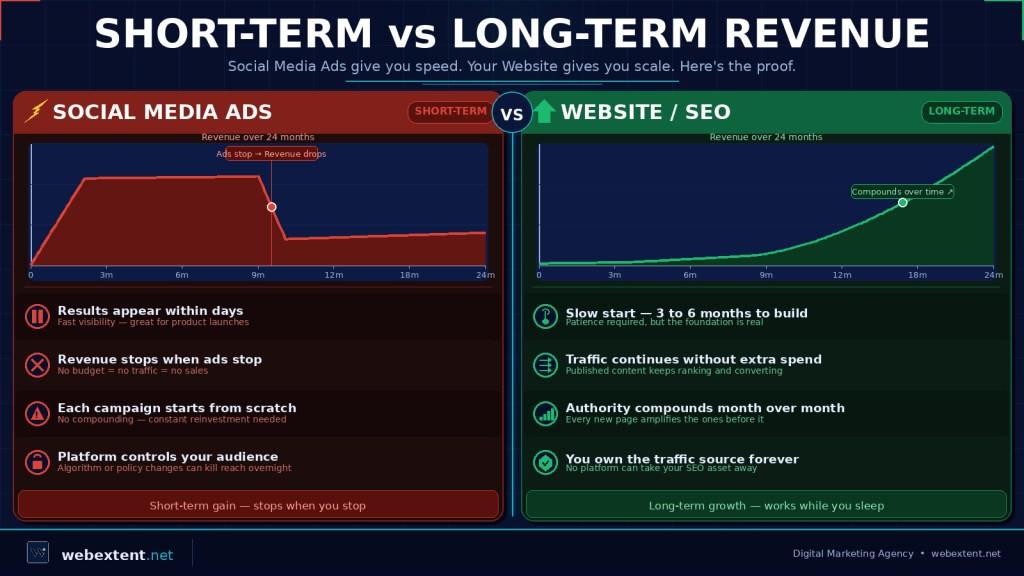
Consider two businesses in the same sector with similar budgets. Business A allocates everything to Facebook ads. Business B splits its investment — running targeted social campaigns for immediate revenue while simultaneously building SEO infrastructure. Eighteen months later, Business A is still paying the same cost per lead. Business B’s organic traffic has grown substantially, its cost per lead from search has dropped, and its ad campaigns are now supported by a website with real authority and conversion architecture.
The social media vs website marketing debate, framed this way, is ultimately a question of whether you want revenue now or revenue that scales. The answer, for most businesses, is both — and that requires both channels working together.
Conversion Power: Where the Real Difference Lives
If you want to understand why websites consistently outperform social media profiles for considered purchase decisions, look at the environment in which each asks the customer to act.
A social media profile is a shared, distraction-saturated space. Your content competes with friend updates, competitor ads, breaking news, and entertainment — all simultaneously. Asking someone to make a purchasing decision in that environment is asking them to concentrate in one of the most attention-fragmented places on the internet.
A landing page is the opposite. There’s no navigation pulling visitors away. There are no competing ads. The headline, supporting copy, testimonials, and call-to-action all work toward a single outcome in a controlled environment. This structural difference explains why professional landing pages consistently convert at higher rates than social profiles for services, subscriptions, and high-consideration purchases.
Furthermore, websites provide complete conversion data. You can identify exactly where users drop off in your funnel, which CTAs generate the most action, and what the true cost-per-acquisition is across every traffic source. That data makes every subsequent campaign smarter. Social media analytics, while useful within the platform, give you only part of the picture.
Cost, ROI, and How to Think About Your Marketing Investment
Website development carries an upfront cost — but it’s an investment in a depreciating-in-reverse asset. A professionally built website continues to attract traffic, convert visitors, and generate leads long after the initial build cost is paid. Ongoing SEO investment adds to that equity progressively.
Social media advertising, in contrast, is a recurring operational expense. It can deliver a strong ROI in the short term, particularly for product-based campaigns with clear margins. However, it doesn’t build equity. Every campaign resets the performance counter. Over a two-to-five year horizon, the compounding return from a website with active SEO almost always outpaces a strategy built solely on paid social.
The most commercially intelligent approach is not choosing one or the other based on cost alone. It’s understanding which channel serves which objective, and funding each accordingly. Social ads for immediate cash flow and audience testing. Website and SEO investment for the sustainable revenue infrastructure that doesn’t switch off when the budget does.
Two Businesses, One Market: Why the System Matters

Business A — The Social-Only Approach: Business A boosts Facebook posts and runs occasional campaigns. They receive engagement — likes, comments, and occasional DM enquiries. But there’s no landing page to send traffic to, no conversion tracking, and no data capture. If a prospect doesn’t message immediately, they’re lost. Facebook’s algorithm shifts, reach drops, and the business has nothing to show for its ad spend except fading awareness.
| Business A has activity. Business B has a system. That distinction is the entire gap between inconsistent revenue and scalable growth. |
Business B — The Integrated Approach: Business B runs targeted Meta campaigns, but every ad links to a purpose-built landing page on its website. The page is designed around one action — a consultation request. Analytics track every conversion. Visitors who don’t convert are added to a retargeting audience. Those who do enter an email nurture sequence. Six months in, Business B has first-party data on hundreds of qualified leads, growing organic traffic from SEO content published alongside the campaigns, and a retargeting pool that converts at lower cost than cold traffic. Its digital marketing spend delivers more every month — not because the budget has increased, but because the system has improved.
When Social Media Should Lead Your Strategy
Not every business is ready for a full website and SEO investment from day one — and being clear about this matters. If you’re a brand-new business validating a product concept, social media advertising lets you test demand before committing to a full build. If your business is highly visual — food, fashion, events — Instagram and TikTok can generate brand recognition quickly at early stage.
If you have a tight initial budget and need cash flow before reinvesting, a well-targeted paid campaign can fund the next step. These are legitimate, strategic uses of social media as a primary channel. The key word, however, is temporary. Social media is an excellent starting point. As a permanent ceiling, it limits growth significantly.
When a Website Becomes the Growth Priority
Certain business objectives simply cannot be met without a professional website. If you’re pursuing national or international reach, organic search is the only scalable, cost-efficient way to achieve it. If you offer high-ticket services where trust is a prerequisite for purchase, a polished website with case studies, testimonials, and clear service architecture is not optional — it’s the difference between closing and losing premium deals.
If you want to compete seriously in your market over the long term, owning your digital real estate is non-negotiable. Competitors with strong SEO authority and conversion-optimised websites will consistently outperform those relying on social media alone, regardless of ad spend.
The Smart Website and Social Media Strategy
The most commercially effective digital strategies don’t treat website vs social media for business as a binary decision. They treat each channel as a component in a connected revenue system — and they design that system deliberately.
Here’s how the integrated model works in practice:
- A targeted social media ad generates awareness and drives traffic to a specific landing page.
- The landing page converts visitors through a single, friction-reduced call-to-action.
- Non-converting visitors are captured in a retargeting audience for follow-up campaigns.
- Converting visitors enter an email sequence for nurturing, upselling, and retention.
- SEO content runs in parallel, building organic traffic that reduces long-term cost-per-acquisition.
- All data feeds back into analytics, enabling continuous improvement across every channel.
In this model, social media is the traffic engine. Your website is the conversion engine. One without the other is incomplete — and the revenue gap between the two approaches compounds over time.
Most businesses that struggle with digital marketing aren’t using the wrong platform. They’re missing the infrastructure that connects platforms into a coherent, measurable system. That’s the actual problem — and the actual opportunity.
How WebExtent Builds Revenue Systems — Not Just Websites or Ads
Most agencies offer you a service. We’re more interested in your outcome.
Before we design a single page or launch a single campaign for a client, we ask a straightforward question: what does this business need in place to consistently convert visitors into paying customers? The answer to that question shapes everything — the website architecture, the SEO approach, the ad strategy, and the way each element connects to the others.
That means websites built around conversion logic, not just visual appeal. It means SEO strategies built around what your ideal customers actually search, not just what has high search volume. It means paid campaigns that send traffic to landing pages designed for a specific action — not generic homepages that leave visitors without a clear next step. And it means tracking every stage of the funnel so the system improves over time, not just at launch.
We don’t believe siloed services serve businesses well. A landing page without traffic is a room with no visitors. Social ads without a conversion destination are spend without a return address. Our approach is to build the full infrastructure — from the first ad impression through to the confirmed sale — so that every element of your digital presence contributes to revenue.
If you’re currently investing in either a website or social media and not seeing the results you expected, the issue is almost certainly not the channel. It’s the system — or the absence of one.
| We’d be glad to take a look at what you’ve built, identify where revenue is being left on the table, and walk you through what a connected digital strategy could look like for your business. No jargon, no pressure. |
Conclusion: It’s Not About Choosing Sides
The website vs social media for business debate is, at its core, the wrong question. Framing it as a choice leads businesses to under-invest in one channel while over-relying on another — and both outcomes cost revenue. When evaluating website vs social media, businesses should prioritize long-term revenue systems over short-term campaigns.
Social media is a powerful tool for generating visibility, testing ideas, and driving targeted traffic quickly. However, without the website infrastructure to convert and retain that traffic, your ad spend has a ceiling it can never break through. A well-built, SEO-optimised website is not a cost — it’s the foundation of a scalable revenue system.
The businesses growing most consistently online aren’t choosing between a website and social media. They’re using social media to fuel their website, and their website to convert that fuel into revenue. The result is a system that compounds — one that becomes more efficient over time, not just more expensive.
Therefore, the question worth sitting with is this: if your social media ads stopped running tomorrow, would your business still generate enquiries? If the answer is no — or even uncertain — that’s the gap a properly integrated website and social media strategy is designed to close.
Take a fresh look at your current digital setup. Where is revenue actually coming from? Where is it leaking? And what would a connected system built around both website and social media look like for your business?
Frequently Asked Questions
Is a website better than social media for business?
It depends on your goals. A website builds long-term revenue equity through SEO, conversion funnels, and owned customer data. Social media delivers faster visibility but lacks the conversion infrastructure and data ownership a website provides. For sustainable growth, a website is the stronger long-term investment — however, the most effective strategies integrate both channels into one connected system.
Can I rely on social media alone for business sales?
You can generate sales through social media, but building your entire revenue strategy there creates serious risk. Algorithm changes, rising ad costs, account restrictions, and policy shifts are outside your control. Without a website, you also have no conversion tracking, no data ownership, and no SEO equity. Social media works best as a traffic channel feeding into a website built to convert.
Which is more cost-effective: a website or social media marketing?
A website involves an upfront investment but builds compounding value through organic traffic and SEO over time. Social media advertising is a recurring cost that stops delivering when you stop paying. Over a 12-to-24-month horizon, a website with active SEO typically delivers a lower cost-per-lead than sustained paid social alone. In the short term, however, social ads can generate revenue faster.
Do I need both a website and social media for my business?
For most businesses, yes. Social media drives fast, targeted awareness. Your website converts that awareness into leads, customers, and long-term organic growth. Using both in a connected strategy delivers significantly better results than either channel in isolation — and reduces dependency on any single platform.
How do a website and social media work together to drive revenue?
The most effective model uses social media ads to send targeted traffic to purpose-built landing pages on your website. Your website converts visitors, captures leads, and enables retargeting of those who don’t convert immediately. SEO content runs in parallel to build organic traffic over time. All data feeds back into your analytics for continuous optimisation. The result is a system where every element supports the others — and revenue compounds rather than resets.
Final Thoughts
Your digital growth strategy is only as strong as the foundation behind it. Whether you focus on a website, social media marketing, or a combination of both, the real results come from having the right system in place.
A well-built website turns traffic into revenue. Strategic social media campaigns drive targeted attention. When both work together, your business gains momentum that compounds over time.
The companies that grow consistently online don’t rely on guesswork — they rely on structure, clarity, and long-term thinking. And that’s exactly where the right partner makes the difference.
If you’re ready to build a smarter digital strategy — one that connects visibility with conversion — the WebExtent team is here to help.
Let’s grow together.
Stay Connected With Us
Follow WebExtent for insights, updates, and practical digital growth tips:
| ▶ YouTube | Subscribe for tutorials, strategies, and behind-the-scenes content. Subscribe Here |
| https://facebook.com/webextent.net/ | |
| https://www.instagram.com/webextentofficial/ | |
| 🐦 Twitter (X) | https://twitter.com/WebExtent |
Tags: social media website creation


0 comments